Think / Able - and Check out My Parkinson's Facebook Page

Think / Able - and Check out My Parkinson's Facebook Page
Thanks for coming by! I appreciate it! Click the picture to follow on to my Facebook Parkinson's Page
Showing posts with label Jack London. Show all posts

Tuesday, April 16, 2019

The Face of Humanity


On March 19, 1945, Hitler laid out a scorched earth decree to destroy the cultural heritage of Europe after he determined he could no longer win the war. This revenge on humanity was entitled the Nero Decree, and were it not for the Monument's Men working within the military, a lot more things would have been destroyed by the bloodthirsty bastards who had held more and more parts of Europe prisoner as they advanced into the form that the Allies combined together to fight and destroy.

Sadly, we lose a lot of the great works that made humanity what it was. Other works were stolen from their owners, who were later killed in concentration camps. This was the ugliness and effects of war. Fortunately, much of the culture that we fought to preserve, in both individual freedoms and liberties, as well as creative and theological pursuits lives on.

Also, somehow, in this war and the great war before it, Notre Dame stood strong and went on.

There's a story that is told in the movie Before Sunset, which Ethan Hawke tells Julie Delpy, where he remarks on how one man was left to the task of pushing the button that would demolish the cathedral at Notre Dame, which had been wired with explosives. He couldn't do it. It was just too beautiful. The same thing happened all over Paris at other monuments.

It (and they) was (were) just too beautiful.


The liberation of Paris did leave Notre Dame safe, but in the end, it would be a series of renovation plans and funding attempts that began in 2017, which would bring the building to its knees (at least it seems to be at this time - an act of terror would just be doubly unthinkable). Unfortunately, the universe is filled with chaotic instances where things happen and slip away. Such is the nature of the universe. Ashes to ashes, dust to dust.

There were many moments in its 800 year history that Notre Dame had a wondrous, beautiful history. Obviously, April 15, 2019, was not one of them. Fortunately, items were rescued while others were previously removed for safe keeping. Who knew that taking down the Apostles would save them from the fate of the spire? The fire could have done more damage. The bell towers and main halls could have been totally consumed. Fortunately, they stand.


I have seen the images and videos of the fires. I watched the video posts back to back to back of the spires falling. I cried real tears and choked up to what this moment was, several times. I'm done watching the fire. What's done is done. It's time to focus on the future.

Out of these cinders, we need to find meaning.

With that, it's hard to put emotion for "things" into an expression of understanding them as something that is more human than material, but to understand why so many people hurt it's important to do just that. We have to understand why we weep for this place as we would a person, since that's what we're doing. In this, it has to be more than a symbol.

Yes, no human being died in this fire (or was reported dead when I wrote this). If anyone suffered injuries, it was done in fighting the fire or saving relics, which included the Crown of Thorns, a Nail of Christ, a fragment of the True Cross, and tombs of holy figures, as well as many priceless works of art.


Who would risk their lives for art? What exists in a creation that makes it stand apart? Is it the talent that it took to create the perfection of the effort? Is it the faith in the mind that willed the hands to create a representation of what the mind saw as meaningful? Is it the technological mastery of tools and skills to just create the work? Is it by sheer virtue of age and time passed, the years that something has stood through the erosive forces of life to still be visible to the eye, maybe a little more faded than in times past, but still here nonetheless? Or is it the theological depiction of stories from 2,000 years ago, which still reverberate in our selves?

Or is it all of the above, or perhaps even none of the above, something else altogether?

I've never been to Notre Dame. Because it was saved, at least in part, someday I will be able to. It won't be the same, but it will still be. As with other versions of the cathedral, parts will be changed, fixed, or removed. New parts will be added. Nevertheless and most importantly, the spirit of Notre Dame will be there, just as it was when people risked their lives to pull items out of there.

Notre Dame is its history, but its also the created art of The Hunchback, which Victor Hugo gave to the world. This was the same Hunchback that our local Lancaster, Pennsylvania, theater, the Fulton, brought to life last year. In it, the 100+ person cast took Hunchback over the top. To our absolute awe, it included a huge choir behind 5 huge bells and a 3-level almost 30-foot bell tower. I know that's hardly the real thing, but something in the power of that story had seen the real thing and felt touched by it enough to make it "real." 

Someone else's inspirations from the actual building made this version of the tale a created work that somehow paralleled human history to represent the meaning of who we are and want to be as a people, fighting injustice, standing for love, and the power to be in spite of life's cruel hand (the power to find ability, even in disability). 

As with all successful art, something inspired a message, which was communicated so vividly and powerfully that the viewer would truly receive that inspiration. Thus, in that moment that they opened the set up to its full size and full cast, something radiated out to the audience and made that musical so much more than just a regular night of entertainment. 

When you feel that expression, you just know. You get it, but you can't put a name on it. You just let it flow through you. I'd like to call it the face of humanity providing the meaning of life.


This is the same type of feeling when I walked into the Sistine Chapel in January for the first time and just cried at the beauty of something so overpowering and holy. I remember feeling that same way at the Grand Canyon, too. I just stood there looking for words and only uttering "wow." Yet at the Sistine Chapel, I didn't know what to say or where to start. There was just so much effort and inspired traces of lives in there. 

What's a person to say or do when confronted with huge swaths of theological history and life meaning at once?

The Sistine Chapel is Michelangelo and some other painters, too (Boticelli among them). We don't often think of them, but they're "on the soundtrack," too (so to speak). So is Daniele da Volterra, though his work is more of a "crime" to the purity of what certain authorities deemed "impure." For these other people, we don't think of this as their greatest hit, but for Michelangelo, we do... no matter how much he resisted coming back for the encore. Now, together with the work of the original artists who worked without fig leafs, this is his life's meaning. Daniele da Volterra's brush can't hide this reality from us.


Thinking of the supernatural connection between man and the divine, something is happening at the Sistine Chapel. As I said, I can't explain what it is or define it by name, but when you see it, you just know. 

And it's thinking about my time there that I know why I cried for Notre Dame, and why I would cry for the things we saw in Greece, Italy, or hundreds of other locations, if they were to fall as did the Buddahs of Bamiyan or any of the other artifactss that are currently being lost to war and looting. It's why the Monument's Men risked their lives before George Clooney was alive to make a movie about their attempts to recover stolen art from the Nazis. That spirit, portrayed in the book of the same name, is why he was inspired to make such a powerful visual statement.

It's why I get upset at graffiti in national parks or drunken parties littering in pristine or simply removed natural surroundings. It's why history and culture matters, whether it's mine or someone else's. It's why I'm thankful for people like the Bad Ass Librarians of Timbuktu. 

This is why we fight for the face of humanity, even if it's not a person, per se.

To a throwaway culture, you don't get a second chance to save a priceless artifact.

Obviously, we didn't throw away Notre Dame, but many of you are like me. You planned to see it way too late. You thought it would always be there. Now it isn't. Why did you wait? If you could have gone, why didn't you?

I think about this now and reflect on our ability to go places and see and do things that will transform us into someone else. I think of a place in Utah and tell myself and the universe, just hang on for one more year. I'm coming.


We spend our time and money on things we value, so why not these things as soon as we can? We live our lives knowing that we have plenty of opportunities to see and do things, but then life happens and we don't ever make it there (I'm so glad my wife saw Notre Dame years ago and many of her family members saw it last year). We get too old. We aren't physically or financially able. It's like in the movie Up, with the adventure book. We define our life by our dreams, and yes, like in the movie, we adjust. But what about the things we should have done, but never did and so we regret what we missed out on?


For some of us, we know we could have done better with managing our hours. Here, it's the time wasters. For other people, it's the poor priorities. For still others, like me and many of the people who come to this site, things like Parkinson's happen. That's me. 

But it doesn't have to be.

We (I included) can live out loud and make the most of the time we can do. Godzilla can rage any minute. King Kong might join him. What are we waiting for? Someday, we will be old men and women with our memories. Will they be good ones? Will we do what we can to use our days? 

Can we follow our dreams to our Notre Dames, no matter what or where they are?

Because somehow in finding these heavenly connections to other worlds, the inspired products of the muse, we experience life's ultimate meaning. We become inspired to our own creativity and ultimate meaning. 

To see this destroyed, whether by a random accident or a deliberate action, we witness the destruction of a part of everything that touched it. Whether it's man's hand on a created work or God's hands on a natural place, something dies. At Notre Dame, a lot of parts of a lot of ghostly forms went up in smoke today. They'll never exist again as their face of humanity drifts away, hoping to be replaced with someone else's life meaning and purpose.

It's up to us and the actions brought on by our tears to recognize the beautiful and to preserve the past / present / future by creating it. No act of destruction can ever advance humanity near the same way as a creating one can.

+++

POSTSCRIPT

Forgive us our trespasses as we forgive those who trespass against us.

Should a person (people) be feeling guilty for ACCIDENTALLY causing this fire at Notre Dame, I hope said person (people can find peace and forgiveness in this moment. I can't even fathom what a burden this could be on a person's mind, especially if it was an accident. In the end, the art is divine, but forgiveness and the ability to make amends are pretty important to. 

We owe that to humanity.

Monday, March 26, 2018

5,000 Hit Posts - Why I Write about My Parkinson's and My Supernatural / Action Fiction!


Above is a video explanation of why I write and why I feel you should write, too (if only to share with yourself and friends). Rather than re-post all of it, I'll just encourage you to watch my video. It's less than 3 minutes, so yeah... good commercial break info.

The essential thesis is Emile Zola's quote, "I am here to live life out loud." In addition, it's about defining yourself and controlling your narrative so others can't make you feel like less than you are. In your writing, you can be you. Be honest, be bold, and be beautifully imperfect. Warts and successes, we are who we are. Never be afraid to be you... even if you're a white-whiskered, chubby-bellied, self-important Parkie rambling about interests few people relate to, you're still you. Be that person who is living life out loud (besides, I'm happy to be all those things because that means that I may have PD, but it doesn't have me)!!


Today is day 2 of 21 straight days to push my blog hard (a new post every day) to move to a place where I can live out my dream to write for more than a hobby. Much of this is based on a decision to educate and advocate for Parkinson's knowledge in places that I go (being visible / being strong / showing my positive). For instance, my wife and I are going to Yosemite in May. Being on a more national front with people helping me spread my story helps show people that I may joke that I'm "Shakes the Hiker," but I'm more than tremors, Parkinson's mask, a dystonia-affected left foot, dysphagia, hyperhidrosis, and many things people don't know about. I'm a guy who's going to push himself to get to places that let others know, "not only are we out here, but we're keeping it 100 (as the kids say)."

Yes, this is about being a professional writer and blogger, but it's about letting people know that we should be choosing to live life and not writing off people when they can still do things (and they want to do them, too!). This applies to anyone with a beating heart. Make your days count! You never know when Godzilla, King Kong, and the other monsters will strike and stop your chances to do.


I won't be posting all of my links on all Facebook pages, so you're going to need to Google follow me or join my Parkinson's Writer Facebook page for constant info. This is because not every post will appeal to the same group, so rather than post about every idea every day, I'll just be sharing links when they're pertinent to the site.

So... for today, I leave you with thoughts on being a writer (both fiction and nonfiction). Here are 12 thoughts on writing based on my experience in the classroom and at the computer.

1. I have written stuff since the late 1980s. Much of the beginning writing was quick story slivers, bad poetry, and pseudo-prose written as rambling literary / emo before I knew much about either.


This fire is what happened to half of the poetry and prose. The rest was shredded. That's OK. It wasn't my baby, and besides, overly emotional in the moment stuff is better to get out and then destroy. Who wants that lying around anyway? In the end, it was all practice. Get your 10,000 hours of practice like Malcolm Gladwell said (no matter who disagrees). As opposed to the rambling emotions, most of my best practice was writing letters to friends while in the Air Force. I could ramble for pages about nothing. Imagine when I had something to say! Additionally, I also learned to type without looking through Instant Messenger. Go figure!

2. I do see that emotional knee jerk expression as a cathartic necessity, but when it comes to the final product, that conflict needs to be resolved and moved beyond before publication. A writer who can control his or her emotions in the moment and just be objective (facts vs. subjective emotions) is achieving one of the first goals in the life of a writer. Commas are further down the list somewhere.

3. The most important trait of a writer is believing that he or she has something worth saying (if you don't, you won't get a word out). Blogging is a great opportunity to write it down and put ourselves out there. I recommend the ready-made fans websites of people like you (that's why I'm publishing to hikers, Parkies, travelers, baseball fans, fans of music I like, and people into the supernatural).

4. It's easy to give it away for free. It's harder to sell it. You only have so many friends and relatives and friends of relatives. That said, when that time comes to sell your books, be patient, figure out a marketing strategy, and make it happen. Don't get discouraged. That's why I have this online blog and this Facebook page for my Parkinson's writing and this page for my supernatural writing. I also have a real deal web page. I encourage you to check them all out! I definitely appreciate the likers and followers. Nevertheless, I wrote the Parkinson's blog for 18 months before I had a 3,000 hit post. More than that, I've written many blogs, and some of them never got near that many hits in all of the posts. When I finally did, the post went to just under 5,500 in 4 days. The comments that went with it felt reassuring. Nevertheless, this isn't overnight success. Additionally, this is still humbling and exciting, though I look to expand my success at getting my experiences and thoughts out to people.

5. Some people are all about creating their brand from day 1. To be a good writer, you need to be all about learning how to achieve the flow first. Practice, practice, practice. Get those words going from A-Z without skipping letters. This is free writing. Don't edit. Just flow. Make Jay-Z proud. Additionally, your brand might be arts and crafts, but you put more into being a parent. You can write what you like or write what succeeds. Which way you go is a value choice. Only you can make that.


7. Before you even think about branding, you better be able to outline and follow it. Remember, you're not Faulkner, Kerouac, Tarantino, or some creative writer flattening out time in a stream of consciousness technique to be artistic. Beginning to Middle to End. The beginning can be Megamind falling to earth, saying, "How did I get here?" That's fine. Then tell the story from the beginning. Gradual reveal is also fine. John Travolta shot and killed in 1 scene and alive and kicking in the next? Don't think about it until you're declared a creative genius. Even then, stay real enough or you'll be Kanye West sampling about being provocative and how nobody understands that. At least he could laugh at himself. Besides, he's got mad bank (even if he's a male Kardashian) should people think he's "cra cra" (and they do).

8. Find a good adviser and a good editor. Don't shake said person off. This person is trying to help you (especially if you aren't paying). Your job is to nod appropriately and do. My editor is MaryAnn (see below). She has done so much to help promote my writing dream. What would I do without her? Mucho gracias! She kept me from writing a Walking Dead ending, and we all know how bad that "who did Negan kill?" episode was for the franchise. As for editing, eventually, you will need to learn grammar. You don't have to be perfect. You'll never get there, but there's acceptable errors and "this is a nightmare." You always want to read out loud for clarity, and keep working on it to get better. When it's done, take a deep breath and move on like Mike Desantis, a stats teacher I learned from, said.


9. There's nothing wrong with being an imitator when you're finding your voice. A lot of my writing is influenced by books I read, movies I watch, songs I listen to, and people I know. At my earliest period of impressionable influence, it was Henry Rollins. The last authors I read that really got to me in that kind of way were Chuck Klosterman, Nick Hornby, Bill Simmons, and other page-turner autobiography / thoughts types. Of course, there was also Henry Miller, Kurt Vonnegut, Jon Krakauer, Edward Abbey, Laurence Gonzales, and Jack Kerouac, but yeah... authors come and go, and we add in as many Ken Burns documentaries as we do of the local ghost story writers flair (here, I think of Charlie Adams). Don't let people make you into Jane Austen unless you're writing about dating customs 200+ years ago. If you want to be Jack London, then make your dogs into the primordial beast persona of yourself! Besides, Jane Austen has nothing to teach about that. All the same, Jack London couldn't write a woman accurately if he had a gun to his head and his life depended on it.

10. JK Rowling was rejected 12 times before she became the first billionaire writer with movies and a theme park to go with her books. Oh, and they reduced her woman's name to initials to sell to little boys, who might not like reading a woman's work. She nodded appropriately, but now she can buy all of us and speak her mind about lots of issues (and she does!). The moral of the story is not to compromise, but rather, it is to know about being patient and tough enough to handle rejection.

11. I didn't meet my wife until 2007 (age 36), but when the time came, I learned from the good and the bad things that I did and others did to me in my relationships to make it work in the now. My wife may not be a writer, but she does support and encourage me. Get yourself some of these people, too. You need love, encouragement, non-writing love, and a ground team. That said, find yourself some writers and readers, too.

12. Have fun with it. Nobody is paying you $1 million for your book until you have something that they feel is worth reading (be it a heroic moment landing a plane on the Hudson or a long story about Hobbits). In our own mind, we may know we have something great, but without that push, we're not even going to be in the bargain bins. I call this the JK ROWLING BLUES. People are told by advertisers what to read, and when that happens, even Wal-Mart sells out of our books. Remember, most people don't just buy a book to buy a book. When they do, they're told what to buy, and then we get 50 Shades of Gray, Stephen King, Dan Brown, Anne Rice, Stephanie Meyer, Michael Crichton, Maya Angelou, Suzanne Collins, and James Patterson. Until then, write to write. Write if people don't buy. If they do, thank them. If they don't, keep writing anyway. In his life, Thoreau would joke about having 900 books in his library, which featured 700 of his own works!

By the way, if you have to give it away to get instant love to get to the paid love later, do it. Here, my 600 pages of The Rules of the Game can be a free download from time to time (on Kindle) in the same way new businesses need to do Groupon. Granted, it's tough to want to pay $10 to give a print book away, but digital love or sample chapters... definitely.


I love me some Groupon! Oh, and I also love me some Tiffany Haddish!


As a bonus, here are Jack Kerouac's techniques for writing (spelling issues are his)...

BELIEF AND TECHNIQUE FOR MODERN PROSE

LIST OF ESSENTIALS  (by JACK KEROUAC)

1.      Scribble secret notebooks, and wild typewritten pages, for yr own joy
2.      Submissive to everything, open, listening
3.      Try never get drunk outside yr own home
4.      Be in love with yr life
5.      Something that you feel will find its own form
6.      Be crazy dumbsaint of the mind
7.      Blow as deep as you want to blow
8.      Write what you want bottomless from the bottom of the mind
9.      The unspeakable visions of the individual
10.   No time for poetry but exactly what is
11.   Visionary tics shivering in the chest
12.   In traced fixation dreaming upon object before you
13.   Remove literary, grammatical and syntactical inhibition
14.   Like Proust be an old teahead of time
15.   Telling the true story of the world in interior monologue
16.   The jewel center of interest is the eye within the eye
17.   Write in recollection and amazement for yourself
18.   Work from pithy middle eye out, swimming in language sea
19.   Accept loss forever
20.   Believe in the holy contour of life
21.   Struggle to sketch the flow that already exists intact in mind
22.   Dont think of words when you stop but to see picture better
23.   Keep track of every day the date emblazoned in yr morning
24.   No fear or shame in the dignity of yr experience, language & knowledge
25.   Write for the world to read and see yr exact pictures of it
26.   Bookmovie is the movie in words, the visual American form
27.   In praise of Character in the Bleak inhuman Loneliness
28.   Composing wild, undisciplined, pure, coming in from under, crazier the better
29.   You’re a Genius all the time
30.   Writer-Director of Earthly movies Sponsored & Angeled in Heaven


As of right now, I'm doing a few things differently (as I said earlier) as your support (a 5,393 hit post about my Parkinson's learning) and the release of my 3rd book, The Rules of the Game, which I put out on Amazon (whose site CreateSpace allows people to vanity print on demand) have shown me that other people believe I have things worth saying as I work on the outline plan and writing for my Parkinson's book to be done by July or so.

As for my current book, it's a supernatural action story. For parents looking to see if it's for teenagers, I do discuss ratings ahead of time for age appropriateness. At some point in the near future, I will be releasing it for free on Kindle.


It's not everyone's cup of tea, but it's something I like creating that keeps me from being PD. At the end of the day, my characters need to be fully developed and realized, so let me write!

Thanks again for the love.

I'm humbled.

Dan.

Thursday, January 25, 2018

The Meaning of Life as Told through Ghost Stories, New Orleans Cemeteries, the 3 Types of Mexican Death, and American Literature


            In Mexico, there are 3 types of deaths. The first is when the body stops living. The second is when the body is lowered into the ground. The final type of death is when the person is forgotten about. If we go back in their history, the picture above (at Chichen Itza) is a representation of people that the architecturally awesome, but brutally murderous Mayas killed... just because that's what they did.


           As a person who reckons himself an armchair philosopher (i.e. I don’t get paid by some academic think tank to philosophize / I don’t hold a degree in it / still, I freely share my opinions on it, contemplate it, and read up on it when I get the chance), I think this makes a lot more sense than the American types of dying / death.

dying is fine)but Death
?0  
baby
i
wouldn’t like
Death if death were
were
good:for
when(instead of stopping to think)you
begin to feel of it, dying
 ‘s miraculous
why?be
cause dying is
perfectly natural;perfectly
putting
it mildly lively(but
Death
is strictly
scientific
& artificial &
evil & legal)
we thank thee
god
almighty for dying
 (forgive us, o life!the sin of Death

            I’d like to think that  the words of the poet e.e. cummings above (punctuation “errors,” to include lack of capitalization in his name, are the author’s) had it right. Americans often view death as something to be feared, though other authors avoided this with a more eastern philosophical view of life as energy for life (recycled into Transcendentalism). This is shown “well” (if you’re an aspiring literary type) in William Cullen Bryant’s “Thanatopsis.” 


            Otherwise, death is a monster movie where our bodies are food for the worms. Here, we end up like skeletons in a horror story, except our cob-webbed forms are unable to spring back to life in order to chase terrified teenagers to their untimely deaths. Death is portrayed in nihilistic terms like a suicidal body that can't be thrown off a bridge anymore (since a town like Ithaca, below, installs nets on bridges to stop this - for good reason - though, it is aesthetically unpleasing) or a homicidal fetish done by serial killers. Other times, it’s purely random rage of gangland murders to kill someone “like it ain’t no thang.” When we aren’t doing that, we live in fear that we will be forever separated from those we love by a wall of alive / deceased, more out of selfishness for our togetherness than the hope that their existence will offer more to others if it gets to keep on doing what it does.  


What’s wrong with this interpretation? What’s right about it? If death is natural and every life is a journey to it, what happens when we get there? We contemplate Heaven, Hell, Purgatory, floating clouds, ghosts, angels, demons, God, the devil, and absolute nothingness (as well as multiple variations of each) when we shuffle off of this mortal coil, but what happens first? What about the living? Why so much focus on the dark parts of death?


If you want to read a very long series of interconnected ideas that I have about the meaning of life, that’s HERE. Long story short, thoughts like this and the combined feeling of a loss of my 2-year old great niece to Alper’s disease, my “Gram’s” Alzheimer’s disease, and my diagnosis of Parkinson’s disease (September 27, 2016, for all intent and purposes - you can read my story beginning HERE, which is what most of my blog is about - other than living life to the fullest, travel, and random thoughts on life), say that we need to choose to live life to make our lives memorable so we’re not forgotten after death. 


Even if it’s only by 1 person or random people reading our stories, looking at our creations, spreading our advice, staring at pictures on our work desk, then there is a permanent memory being created.


Yet, in my opinion, we mistake death for the need for gore, and gore for horror, when real horror is a sense of fear of many different things (to include the failure of our bodies - a particular concern with people with Parkinson's). When we live life as a challenge to overcome hardships, to adventure to greatness, and to overcome evil, we have a lot of chances to test ourselves at a high level. Why get caught up in the train wreck of failure or the chance we might not succeed?

Salem Witch Trials Memorial

We mistake villains for the protagonist, when they are the antagonist. In life, they may stand triumphant against our heroes, but shouldn’t we celebrate those who vanquish hatred, evil, corruption, murder, and enslavement (in all their forms)? Shouldn’t we celebrate that effort, even in failure, as opposed to the knife that kills them or the bullet that “pops a cap” in them?

Rise of the Jack O' Lanterns - Long Island, New York

We demand the visualization of death in its most extreme form, but we forget the feelings Aristotle spoke of when he expressed how the spectacle should never take over the emotion of the scene (in Poetics, if you’re interested in reading it). Why gross people out when we can simply reflect on the effects of the action? Isn’t this what characterization and author’s purpose are about?

Shepherdstown, West Virginia, ghost hunt

For me, I believe in Jack London’s credo ("I would rather be ashes than dust! I would rather that my spark should burn out in a brilliant blaze than it should be stifled by dry rot. I would rather be a superb meteor, every atom of me in magnificent glow, than a sleepy and permanent planet. The proper function of man is to live, not to exist. I shall not waste my days in trying to prolong them. I shall use my time."). I believe that I may have Parkinson’s, but it doesn’t have me. I believe that there’s a lot of people to love (in varying ways) with the rest of my life (46-?). I won’t stop doing the things I can do in the ways I can do them, with people who enjoy them (unless to do them puts myself and others at an unnecessary risk).

Hawk Mountain - boulder loop with hand over hand ascents - last summer, solo.

I want to follow Dylan Thomas’s words (“Rage, rage against the dying of the light!”) or at least Thorton Mellon’s interpretation of them (“I don’t take shit from nobody!”). I want to overcome my negativity like Robert Frost did (“The woods are lovely, dark and deep, but I have promises to keep, and miles to go before I sleep.”).


And yes, even though I write ghost stories that feature monsters, demons, and things that go bump in the night, I feel that in creating this world, it’s all about facing up to evil with positive energy. To be honest, the hardest thing I had to do was to create a really violent murder in the book Dead Mouths (available here). Sure, it was done, but it was more from the perspective of having found the body afterward. What was done was stated. It was gruesome, and it took a lot out of me. It took so much out of me, in fact, I couldn’t write the book again for a month after that. What’s more, it was one evil person killing another person, who was also evil, though not as dark and deadly. This created the sense that said murderer was heinous, and I would do it again, but at the same point, it was hard to do.


Even eliminating good characters isn’t easy. If they die in the right way, I feel it is necessary (and better than creating invincible characters that leave no suspense), but it’s not easy to just write a life and then to lose that person. When written well, characters can be just as alive as people. I guess that’s why I love the message of Luigi Pirandello’s 6 Characters in Search of an Author.
In the end, a character or a life should be memorable. We should write things to have them inhaled. Even at over 600 pages, all actions in my last and current should be memorable (or Anne Rice’s 950+ pages that are about 1.5 times in the Mayfair Witches, which are as filled as 1 of my pages!).


For me, this is a direct correlation to why I like cemeteries. Even before Edgar Lee Masters’ Spoon River Anthology (a collection of epitaphs written to reflect the lives buried in an Illinois cemetery), I found certain graves magnetic. Maybe they were those of a hero. Maybe they were just architecturally wonderful.


In order, Emerson, Hawthorne, Alcott graves in Concord, Massachusetts.


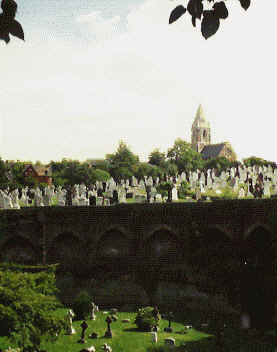
These 2 pictures were taken in Nottingham, England

For that, I loved the graves of New Orleans, Louisiana. Whether they are the future resting place of Nicholas Cage (well, not his - that looks goofy) or the pretend and real resting places of voodoo queen Marie Laveau, there is something that draws people to the mausoleums of the Crescent City. Depending on where you are in the city, some stones are haunting, but some are well-kept. All of them tell stories. They mark the lives of beautifully imperfect people whose lives were lived for something that they wanted to be remembered and never lost to time. Rather than to go into the ground anonymously, they left behind a statue that tells that they lived.
As William Faulkner said, "The past is never dead. It's not even past."


First 5 pictures Metairie Cemetery
Next 3 pictures Lafayette Cemetery
Final 6 pictures St. Louis Cemetery #1
Of these, #2 Marie Laveau's "fake" grave
#3 her real grave (unmarked - has X marks though)
#6 Nicholas Cage's grave to be

All pictures, color and black and white can be found in albums HERE - scroll down.

Sure, Thoreau said, “Nations are possessed by an insane ambition to perpetuate themselves by the amount of hammered stone they leave.” However, for all the minimal living he did, he left a hammered stone, too. I guess he knew something... even if it was only a small stone on the family plot.

Thoreau's grave is in the same cemetery in Concord as the above 3 authors

This brings us back to the beginning. If the first type of death is the body, then it’s going to happen. Things go kaput. So it goes. Why prolong the inevitable to live off of machines to age 120?!! Live out loud as Emile Zola said. Then, we should accept that we’ll go into the ground and so will our loved ones. Sure, there will be tears, but for me, I want a jazz band funeral. I think they can play the part of Bob Marley’s “No Woman, No Cry,” where he repeats “Everything is gonna be all right, everything is gonna be OK” over and over. Then he can go into any Louis Armstrong they want since that’s what jazz bands do. After that, everyone can just tell stories about how awesome / goofy / weird / deep / annoying I was. I’ll be OK, and so will they.


After all, I’ll be batting third for the Cosmic All Stars and playing first base.