Think / Able - and Check out My Parkinson's Facebook Page

Think / Able - and Check out My Parkinson's Facebook Page
Thanks for coming by! I appreciate it! Click the picture to follow on to my Facebook Parkinson's Page
Showing posts with label Alzheimer's. Show all posts

Thursday, January 25, 2018

The Meaning of Life as Told through Ghost Stories, New Orleans Cemeteries, the 3 Types of Mexican Death, and American Literature


            In Mexico, there are 3 types of deaths. The first is when the body stops living. The second is when the body is lowered into the ground. The final type of death is when the person is forgotten about. If we go back in their history, the picture above (at Chichen Itza) is a representation of people that the architecturally awesome, but brutally murderous Mayas killed... just because that's what they did.


           As a person who reckons himself an armchair philosopher (i.e. I don’t get paid by some academic think tank to philosophize / I don’t hold a degree in it / still, I freely share my opinions on it, contemplate it, and read up on it when I get the chance), I think this makes a lot more sense than the American types of dying / death.

dying is fine)but Death
?0  
baby
i
wouldn’t like
Death if death were
were
good:for
when(instead of stopping to think)you
begin to feel of it, dying
 ‘s miraculous
why?be
cause dying is
perfectly natural;perfectly
putting
it mildly lively(but
Death
is strictly
scientific
& artificial &
evil & legal)
we thank thee
god
almighty for dying
 (forgive us, o life!the sin of Death

            I’d like to think that  the words of the poet e.e. cummings above (punctuation “errors,” to include lack of capitalization in his name, are the author’s) had it right. Americans often view death as something to be feared, though other authors avoided this with a more eastern philosophical view of life as energy for life (recycled into Transcendentalism). This is shown “well” (if you’re an aspiring literary type) in William Cullen Bryant’s “Thanatopsis.” 


            Otherwise, death is a monster movie where our bodies are food for the worms. Here, we end up like skeletons in a horror story, except our cob-webbed forms are unable to spring back to life in order to chase terrified teenagers to their untimely deaths. Death is portrayed in nihilistic terms like a suicidal body that can't be thrown off a bridge anymore (since a town like Ithaca, below, installs nets on bridges to stop this - for good reason - though, it is aesthetically unpleasing) or a homicidal fetish done by serial killers. Other times, it’s purely random rage of gangland murders to kill someone “like it ain’t no thang.” When we aren’t doing that, we live in fear that we will be forever separated from those we love by a wall of alive / deceased, more out of selfishness for our togetherness than the hope that their existence will offer more to others if it gets to keep on doing what it does.  


What’s wrong with this interpretation? What’s right about it? If death is natural and every life is a journey to it, what happens when we get there? We contemplate Heaven, Hell, Purgatory, floating clouds, ghosts, angels, demons, God, the devil, and absolute nothingness (as well as multiple variations of each) when we shuffle off of this mortal coil, but what happens first? What about the living? Why so much focus on the dark parts of death?


If you want to read a very long series of interconnected ideas that I have about the meaning of life, that’s HERE. Long story short, thoughts like this and the combined feeling of a loss of my 2-year old great niece to Alper’s disease, my “Gram’s” Alzheimer’s disease, and my diagnosis of Parkinson’s disease (September 27, 2016, for all intent and purposes - you can read my story beginning HERE, which is what most of my blog is about - other than living life to the fullest, travel, and random thoughts on life), say that we need to choose to live life to make our lives memorable so we’re not forgotten after death. 


Even if it’s only by 1 person or random people reading our stories, looking at our creations, spreading our advice, staring at pictures on our work desk, then there is a permanent memory being created.


Yet, in my opinion, we mistake death for the need for gore, and gore for horror, when real horror is a sense of fear of many different things (to include the failure of our bodies - a particular concern with people with Parkinson's). When we live life as a challenge to overcome hardships, to adventure to greatness, and to overcome evil, we have a lot of chances to test ourselves at a high level. Why get caught up in the train wreck of failure or the chance we might not succeed?

Salem Witch Trials Memorial

We mistake villains for the protagonist, when they are the antagonist. In life, they may stand triumphant against our heroes, but shouldn’t we celebrate those who vanquish hatred, evil, corruption, murder, and enslavement (in all their forms)? Shouldn’t we celebrate that effort, even in failure, as opposed to the knife that kills them or the bullet that “pops a cap” in them?

Rise of the Jack O' Lanterns - Long Island, New York

We demand the visualization of death in its most extreme form, but we forget the feelings Aristotle spoke of when he expressed how the spectacle should never take over the emotion of the scene (in Poetics, if you’re interested in reading it). Why gross people out when we can simply reflect on the effects of the action? Isn’t this what characterization and author’s purpose are about?

Shepherdstown, West Virginia, ghost hunt

For me, I believe in Jack London’s credo ("I would rather be ashes than dust! I would rather that my spark should burn out in a brilliant blaze than it should be stifled by dry rot. I would rather be a superb meteor, every atom of me in magnificent glow, than a sleepy and permanent planet. The proper function of man is to live, not to exist. I shall not waste my days in trying to prolong them. I shall use my time."). I believe that I may have Parkinson’s, but it doesn’t have me. I believe that there’s a lot of people to love (in varying ways) with the rest of my life (46-?). I won’t stop doing the things I can do in the ways I can do them, with people who enjoy them (unless to do them puts myself and others at an unnecessary risk).

Hawk Mountain - boulder loop with hand over hand ascents - last summer, solo.

I want to follow Dylan Thomas’s words (“Rage, rage against the dying of the light!”) or at least Thorton Mellon’s interpretation of them (“I don’t take shit from nobody!”). I want to overcome my negativity like Robert Frost did (“The woods are lovely, dark and deep, but I have promises to keep, and miles to go before I sleep.”).


And yes, even though I write ghost stories that feature monsters, demons, and things that go bump in the night, I feel that in creating this world, it’s all about facing up to evil with positive energy. To be honest, the hardest thing I had to do was to create a really violent murder in the book Dead Mouths (available here). Sure, it was done, but it was more from the perspective of having found the body afterward. What was done was stated. It was gruesome, and it took a lot out of me. It took so much out of me, in fact, I couldn’t write the book again for a month after that. What’s more, it was one evil person killing another person, who was also evil, though not as dark and deadly. This created the sense that said murderer was heinous, and I would do it again, but at the same point, it was hard to do.


Even eliminating good characters isn’t easy. If they die in the right way, I feel it is necessary (and better than creating invincible characters that leave no suspense), but it’s not easy to just write a life and then to lose that person. When written well, characters can be just as alive as people. I guess that’s why I love the message of Luigi Pirandello’s 6 Characters in Search of an Author.
In the end, a character or a life should be memorable. We should write things to have them inhaled. Even at over 600 pages, all actions in my last and current should be memorable (or Anne Rice’s 950+ pages that are about 1.5 times in the Mayfair Witches, which are as filled as 1 of my pages!).


For me, this is a direct correlation to why I like cemeteries. Even before Edgar Lee Masters’ Spoon River Anthology (a collection of epitaphs written to reflect the lives buried in an Illinois cemetery), I found certain graves magnetic. Maybe they were those of a hero. Maybe they were just architecturally wonderful.


In order, Emerson, Hawthorne, Alcott graves in Concord, Massachusetts.
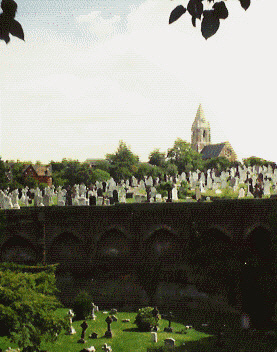

These 2 pictures were taken in Nottingham, England

For that, I loved the graves of New Orleans, Louisiana. Whether they are the future resting place of Nicholas Cage (well, not his - that looks goofy) or the pretend and real resting places of voodoo queen Marie Laveau, there is something that draws people to the mausoleums of the Crescent City. Depending on where you are in the city, some stones are haunting, but some are well-kept. All of them tell stories. They mark the lives of beautifully imperfect people whose lives were lived for something that they wanted to be remembered and never lost to time. Rather than to go into the ground anonymously, they left behind a statue that tells that they lived.
As William Faulkner said, "The past is never dead. It's not even past."


First 5 pictures Metairie Cemetery
Next 3 pictures Lafayette Cemetery
Final 6 pictures St. Louis Cemetery #1
Of these, #2 Marie Laveau's "fake" grave
#3 her real grave (unmarked - has X marks though)
#6 Nicholas Cage's grave to be

All pictures, color and black and white can be found in albums HERE - scroll down.

Sure, Thoreau said, “Nations are possessed by an insane ambition to perpetuate themselves by the amount of hammered stone they leave.” However, for all the minimal living he did, he left a hammered stone, too. I guess he knew something... even if it was only a small stone on the family plot.

Thoreau's grave is in the same cemetery in Concord as the above 3 authors

This brings us back to the beginning. If the first type of death is the body, then it’s going to happen. Things go kaput. So it goes. Why prolong the inevitable to live off of machines to age 120?!! Live out loud as Emile Zola said. Then, we should accept that we’ll go into the ground and so will our loved ones. Sure, there will be tears, but for me, I want a jazz band funeral. I think they can play the part of Bob Marley’s “No Woman, No Cry,” where he repeats “Everything is gonna be all right, everything is gonna be OK” over and over. Then he can go into any Louis Armstrong they want since that’s what jazz bands do. After that, everyone can just tell stories about how awesome / goofy / weird / deep / annoying I was. I’ll be OK, and so will they.


After all, I’ll be batting third for the Cosmic All Stars and playing first base.


Monday, May 22, 2017

Jonathan Kozol's Theft of Memory REVISITED SEPTEMBER 2018


Minor updates in September 2018 - see also THIS for more about my Gram.

            A long time ago in a galaxy far, far away, I read a pair of books that knocked my socks off. These books, SavageInequalities and Death at an EarlyAge, both by Jonathan Kozol, reflected the feelings of how children in the inner cities were abandoned to economic inequality and the brutal issues that go with them. It’s easy to process how, even now, reading those books now could make a person feel like he or she is just like I was when I read them in 2000, inhaling them and wanting to change the world by making such a large leap to affect the world.


            And for a fair bit of time, I really and truly considered it until I realized I didn't have what that environment took in the second half of my student teaching with some tough luck 6th graders (though some were really and truly great kids).

            Of course, like anyone compelled to move toward a program that they advocated for, like Teach for America, there is the reality of why that huge endeavor is such a "noble idea" (registered trademark) and, at the same time, an unattainable victory for the vast majority of people who enter into it (though not all – some people are truly able to connect in such a tough environment and we need more people like them and Kozol fighting for others). Such is why Teach for America has a meticulous screening process before depositing well-meaning suburban people into inner city classrooms that present more challenges than a good social justice warrior could possibly figure out a way to battle through.

            Rescuing worker people (i.e. those people teaching) from these conditions just isn’t the end goal of this program (though it is a necessity). Rather, they want to affect as many children as they possibly can. Unfortunately, The Onion’s different realities of this (A and B) are more real for many people who leave the show and get put through this show.

I remember one girl who got disqualified at the second Teach for America interview. She was a strong student that I worked with, a cute, bubbly college gal, and a committed savior of the world (not that there's anything wrong with that). She would have given her all, but they saw something in her. Maybe it a bad interview, but more likely, it was just that she didn’t have a tough disciplinarian bone in her body or they sensed that she couldn’t have handled the failure of so many people despite giving it her all part. Failure sucks, but failure is worse when our own failures lead to other people’s failures or failing to meet subjective value terms of success (after all, not everyone is going to create a situation like Stand and Deliver). Even with 100% effort and a smile on her face, she just didn’t have something in her interview to be allowed to continue into it. I remember that she was heartbroken about this and how I thought that they did her a favor since she needed to grow into the full-fledged adult version of herself in a different way.

Her life was meant for something else. I’m not sure what since we were never close, but still, I’m sure she’s doing something else exceptionally. However, the great endeavor of getting in there and affecting people with education when they never got it before is such a tough battle that represents a bigger challenge than almost anything. To be a role model, everyday teacher, mentor, assistant, helper, or anything like that to include a playground leader type babysitter / daycare center worker is something that seems more attainable and more purposeful for people learning the ropes (and I remember going through my education classes thinking that a lot of elementary education majors would have done better in roles like daycare center worker since they didn't have enough across the curriculum skills to teach English and Math). I say that in a serious way that in no way demeans those jobs since we need great caring and intelligent people to do them, but rather to say those jobs takes teaching reading, math, or science EXCELLENTLY out of the equation and doesn’t fight to get homework turned in while still fighting for these kids’ breakfast and lunch as well as a positive tomorrow for kids who are wrestling with that prison sentence of youth, which faces down gangs, poverty, and anything that could implode in the early levels of Maslow’s food, clothing, shelter, and safety.

            I can’t imagine living like that. I don’t think anyone who didn’t live life like this could envision it, but I say once again that I’m glad that there are people who can do this and do this well enough to make dreams like 90 90 90 schools a hope. When they can give the real and get the results, then they have truly achieved something, even if the number above is too much of a stretch.

I know how in my experiences in 16 years of teaching, when wrestling to have students complete homework and read assignments as well as to deal with attitude, I’ve felt challenged to the extremes of my ability, and that doesn’t even get into prep time, overcoming life issues, redirecting expectations, speeding things up for the fast students, and slowing things down for the slow students while still grading and coming to every show as much of 100% on as I can be. Teaching is tough. It’s not just showing up and processing data. It’s about giving a hoot and having heart. I couldn't imagine doing that in a situation like this, and for those who do, my hat is off in salute to you.

For this, even though I know my calling is never going to be that of Mr. Kozol in the mid 1960s, I find his commitment and efforts to educational advocacy and empowerment are top notch incredible.

Recently, I had been looking at his books for a student of mine who is truly incredible. Said student spent a large chunk of her life giving back in difficult conditions (a decade or so of missionary nursing work in Guatemala), and I though these books would benefit her future. As I was looking for them, I came across Kozol’s latest work The Theft of Memory, which was about his parents’ death and his father’s Alzheimer’s disease. As my grandmother also had Alzheimer’s, I felt compelled to read it seeing as it came from a writer I truly respect.


            When I picked this up, I thought I would think more about my Gram while I read it, but I didn’t. I did think about her peripherally, but Jonathan’s relationship with his father Harry, who he called “Daddy,” reflected on a neurologist who used hermeneutic phenomenology to express the early days of his diagnosis and his need to be diagnosed for a situation he, himself, had treated and that now would come to reflect his final days. To me, that was something very valuable, both for neurological insights and for personal empathy and understanding, which are, as always for Kozol, very strong.

Much of the senior Kozol’s life reflected on his being a doctor, his marriage, his failing body, and how he treated and analyzed Eugene O’Neil (a famous American playwright) and Patty Hearst as well as a murderer named Albert Desalvo. To me, I related more to those sections out of solid interest in the cases as well as the history of them. Much of the talk of Kozol’s mother, also suffering from age-related memory loss, felt like it plodded through save for her revelations of the complications of being married to Harry and their infidelities, which somehow felt like “something that happened” while each of them did what they had to do in order to make their team work.

As that infidelity is not my life, I can't justify or explain it, but it was something that was their normal.

The story traces the arc of diagnosis to death with memories that come from his father’s medical notes. In that time, his father goes from nursing home back to his home through his son’s love and some amazing caregivers being there for him until Harry’s body finally gave out at 102 years.

Here, I did think of my Gram. I had spent many weekends with her until late elementary school. I got to hang out on weekends, play with Star Wars figures, make forts, and be with my Gram, who I don’t really remember talking much, though she was kind and loving consistently. If not for her, I wouldn’t have had near as many Star Wars figures, that’s for sure!

My Gram did her fill-in puzzles all the time. When she was diagnosed, she was still doing them, but when they were looked at to see how much of her comprehension was left, the letters were gibberish and not words. She was still chain smoking. That was something she remembered she did, but eventually, she forgot that, too. Isn't it funny how, sometimes, the worst can do OK things, too?

Eventually, Alzheimer’s patients forget a lot of important, loving things going back through the years, and yeah, these aren't OK.

The last memory of my Gram is Christmas 1990 after the early days of Air Force training. I picked her up at her care facility in my uniform. She didn’t remember me, and it just hurt. I had a lot of hurt at that point in my life after struggling to adjust to the Air Force, but something in that situation put the icing on the cake.

I remember seeing her again in 1992 and 1993, but after that I never saw her before she died in 1994. I was in England at the time, and I couldn't make it home for the funeral. It was just too far and too much for the family to make work since I was in England.


Nevertheless, in reading The Theft of Memory, the end of it (final 3 paragraphs of the very powerful epilogue) put the last 3 decades into perspective.

            “It will soon be seven years since the night I bent down by his bed to press my ear against his chest and listen to his breathing and his life come to the end. But even now, and even after rounding out the story of his sometimes turbulent complexity, as I’ve felt obliged to do in order to keep faith with the reality of who he was, it is the reaffirming memories that crowd out all the rest.

The sense that I was on a journey with my father – seventy-two years is a good big piece of anybody’s life – did not end abruptly on the day I buried him. On cold November nights when I’m in a thoughtful mood or worried about problems with my work or personal missteps I have made, and go out walking by myself along the country roads around my house, I like to imagine that he’s there beside me still, tapping the old cane of his, making his amusing comments on the unpredictable events and unexpected twists and turns in other people’s lives.

Perhaps over the next few years, that sense of the continuing companionship will fade. It probably will. But some part of the legacy my father and good mother gave me will, I know, remain with me even when their voices and their words and the expressions on their faces and the vivid details of their life’s adventure become attenuated in the course of time. Some of the blessings that our parents give us, I need to believe, outlive the death of memory.”

And here is where I knew I learned from her. I was given time to be me. Pictures of her are still in my office. I never knew her as a wife (my grandfather Dan died before my dad was 2). I never thought of her as a single mother, but she was to my dad and his half-brother Bob. She did housekeeping at a nursing home to make ends meet. All in all, she was a tough lady, and for all she did for me, my dad has gone on to do this for my godson.


If this is a review of the book, then the book is 4/5 though I don’t see myself rereading it, though the last chapter was powerful. The stories of nursing home failure and finding meaning with powerful caregivers resonate that there are people who care and make a difference out there.

One of those people is Jonathan Kozol. If you want to see how his father’s memories play out in him, the ones that fought with him, pushed him, and encouraged him, are all on display in the videos of him. Check it out. You’ll be glad you did. Who knows? Maybe you’ll be influenced to make a difference in a tough luck situation and have what it takes to do it.

We definitely need good people who can push through to be great for others in many fields.