Think / Able - and Check out My Parkinson's Facebook Page

Think / Able - and Check out My Parkinson's Facebook Page
Thanks for coming by! I appreciate it! Click the picture to follow on to my Facebook Parkinson's Page
Showing posts with label Black Diamond trekking poles. Show all posts

Sunday, March 25, 2018

The Beauty of Overcoming Parkinson's disease Apathy to Find Beauty in Nature and Ourselves


My video thoughts on pushing ourselves through our hurdles.

Yesterday, I spent the morning with the Standing Stone Trail Club (in Central Pennsylvania). These are some of the toughest "Old Timers" (their name for themselves), who routinely clear paths on trails, that I have ever seen. They do this...

1) Because people need 18 inches of space to hike the trails.

2) Because they have the skill, alone or in groups, to do this.

3) Because they have the time to do it.

4) Because they find it to be fun.

As a person who lives 2-3 hours away, I can't get up there often, nor can I find time to get up there now to help them (especially now that I have Parkinson's), but they are among a group of great people in every area who do this for the benefit of all outdoor type people.

Trails don't clear themselves. Someone has to do it.


The top group is a typical work crew. By the way, the lady in the middle and the gent to her right were celebrating their wedding anniversary that day. The next picture is a typical path clear. Maintainers haul equipment uphill, over rocks, back trails, and make their days count. On many sections of the trail, a hike could take 30-60 minutes a mile depending on ability (and that's not carrying power tools and fuel for them). These people do all of this routinely, and they do it after using rock pry-bars to set stepping stones / stair stones in place. This is just one reason why they won Trail of the Year in 2016. 

Many of them are humble, so I won't say who's who, but in that last picture, you will see men who represent those who created the trail, led the trail group, created maps, maintained land, promoted its use, protected it for preservation, raised + maintained funds for it, and made the signs that take you through it.

A youngen' like me is in awe of how they spend their spare time!

Oh, and there's one guy in that picture who did the 1,000 Steps 7 times for his 70th birthday. At his best, he was doing 10 minutes to the top on the monster half mile (850 feet, .52 miles - my best in 2014 was just under 26 minutes). Why not? If you can, make it happen! Even as life and its calamities happened and he got older, he kept doing it. Why not? At some point, we all go on our last ascent. We just don't know when. Until then, we still do our things in full or in degrees or make it possible for others to do it (and then we live vicariously through them).

That's what it's about.

For me, after a winter of pneumonia and hypoxia wrecked up my breathing, I've been itching to get out in the fresh air. Unfortunately, to get myself in motion Saturday, I really had to motivate myself through Parkinson's apathy (hidden symptoms) to start the hike on the 1,000 steps as opposed to somewhere flatter and less scenic (and to think I'm only in stage 2 of 5, so this will get more prevalent as my UPDS numbers go up), but when I pulled over into the parking area and put the Sorel boots on, I was off like a herd of turtles! However, I was off!


After about an hour of ascent / talking to hikers / taking photos, I made it through the snow and ice. I'm glad I did. The view was beautiful, but the feeling was even better as I let out my Ric Flair style WOO! to the world. As I stood there staring at the mountains of Mapleton, Pennsylvania, I talked to another guy who was up there despite being on chemo. His positive nature was humbling, and his strength and drive was contagious.

There's a lot of those people out in the world, but not enough. 

Here's to all of us being one of those people, whether in the mountains or valleys, for someone else!

And here's to all of us, as well, who conscientiously do our best to place one foot in front of another to get down safely after enjoying the trip out..

Thanks for reading.


Saturday, February 17, 2018

Hiking Lessons for Mindsets and Feet: Having the Right Equipment is Everything (Especially for Mild Dystonia, Parkinson's, and Hyperhidrosis)!!


            In August of 2013, I had this grand dream. After getting off my chubby butt for the better part of 4 months, I felt that I could do a 5-6 day trek (with backpack) of the entire Standing Stone Trail (under 75 miles or so at the time if you include the distance from parking lot to the sign). I learned many things on the 20 miles of the journey I fought my way through over the 2 days I spent attempting the trail. Most of them were in line with, "Don't think; it can only hurt the ball club." Others were along the line of "rock hiking is slower and tougher than regular hiking."


1)      For me, there was no reward for starting and not finishing a task that isn’t accomplishable. Sure, I went out and experienced a part of it, while learning what not to do next time (a lot of what I did), but that's it. If you're doing something like I did, you know that we get our pictures and memories of what we saw, but if the goal is the finish line, we lost if we don't make it, and if we only go 1/3 of the way, we lost big. Thus, it’s important to have realistic goals and redefine success as pleasure and opening our minds to the flow of losing ourselves in the moment of productive accomplishment. Mihaly Csikszentmihalyi and his take on flow / optimal experience would be proud of us if we could find something we enjoy that much that we can make time vanish while creating / achieving (as long as it's not video game victories).


2)      “Getting to the top is optional, but getting down is mandatory (Ed Viesturs).” From a book that is entitled No Shortcuts to the Top, I should have been learning that a solid overnight back and forth would have been better to start (and at this point in my life, too), but I was electing to go all or nothing, so yeah. Not close and no cigar. I won’t say I’ve given up on over-nighters, but I’d just prefer to hike in and out to shelters instead. Now that I'm diagnosed with Parkinson's, life has changed BIG TIME. I’ve learned I’m more about the experience of seeing neat things than hauling a backpack day after day without a shower or without fresh cold water. As a Parkinson’s person with hyperhidrosis (I wrote about that HERE), I absorb and sweat out water quickly. Having almost 200 ounces of water on a sunny summer day doing 23 miles at Blue Marsh is about half of what I really want for something like that (I also want Clif Shots and gummy blocks - another of my favorite things I wrote about HERE and in its concluding part HERE. This is when I learned how they (and companions) could get me back from Arizona's Wave in 1 piece).


3)     On that note, I learned that there’s no reward for getting seriously injured or killed in some remote wilderness. Emergency rescues cost money. Hospital prices can be brutal, even with insurance (and sometimes, insurance won't cover it). The key is to train extensively and push ourselves just beyond our limits, not to 5 times our limits. Besides, we have people that love and need us. Remember, don't do stupid stuff or s**t.


4)     Always have an emergency way out. Companions for hikes are good, too. I went solo, which was pretty much my only option because I didn’t know anyone to go with. I had met and been influenced by one thru-hiker at the time (Lakeland, who is pretty much one of the premier long-distance elite hikers out there. At the time, he had accomplished the 5,500 Eastern Continental Trail during a year-long hike that also encompassed the Appalachian Trail), and the hike I was going to be on wasn’t going to be his type of hike. Hence, I did mine as a solo journey. Day 2, I woke up with blisters. Ten hours later, I was desperately trying to call my wife from an area of zero cell reception. I finally got in touch with her, but to put it in simplest terms, it wasn’t easy for her to find the unmarked dirt road that I was hiking to (and she was driving a Mini!). Let’s just say, at the end of the day, it’s nice to have someone who loves us enough to keep searching after driving 2 hours to rescue us from dehydration, exhaustion, and blisters. It's even nicer when said person doesn't say, "I told you so."


5)      Don’t carry more weight than you have to. I did. As the character Katz from Bill Bryson’s A Walk in the Woods learned, people will hate your guts if you throw excess weight into the forest. Food weight doesn’t go down fast enough to make it easier to ascend big mountains. Water weight also adds up for us hyperhidrosis types (he says while growling at the ultra-light types!). It doesn’t need to be compounded with lots of extra clothes. It also needs to be replenished quickly. Conserving water isn't smart for a hyperhidrosis hiker.


6)      Having the right equipment is everything! For instance, when the trek was over, I replaced my walking stick with Black Diamond trekking poles. And yes, like Oprah would say, “These are one of my favorite things.” As Lakeland said, they put us in four-wheel drive. It’s true; they do. They also help my Parkinson’s balance and my dystonia left foot as I ascend mountains and traverse boulder fields. Having them and my other essentials for all season (bear mace, Microspikes, and an ice ax) make a hell of a difference in being able to make it through. Someday, I'll be using mine as a "cane."


Prior to the trip, I had bought an REI tent, backpack, sleeping bag, ground cover, and other little supplies to take my Camelbak daypack (another one of my favorite things) and turn it into an overnight pack. I bought a ton of Cliff Bars (another of my favorite things) and dried food since I had no stove to cook with. And yes, they added up in weight. Knowing what I do about the need to stay hydrated on a pretty much dry trail, I'd rather see the trail over spread out days instead of a week straight. And this is what I currently do and have done. It’s better for my Parkie self to stay alive than to push it too hard.


That said, for a hiker, I would say that the most important bit of equipment other than water is whatever happens to or goes on our feet. Now, I carry blister pads. If I went any kind of distance in 2 days, I would have some kind of healing lotion for my paws as well. It might be weight, but anything that can soothe the feet is a good thing.
This brings us to footwear.


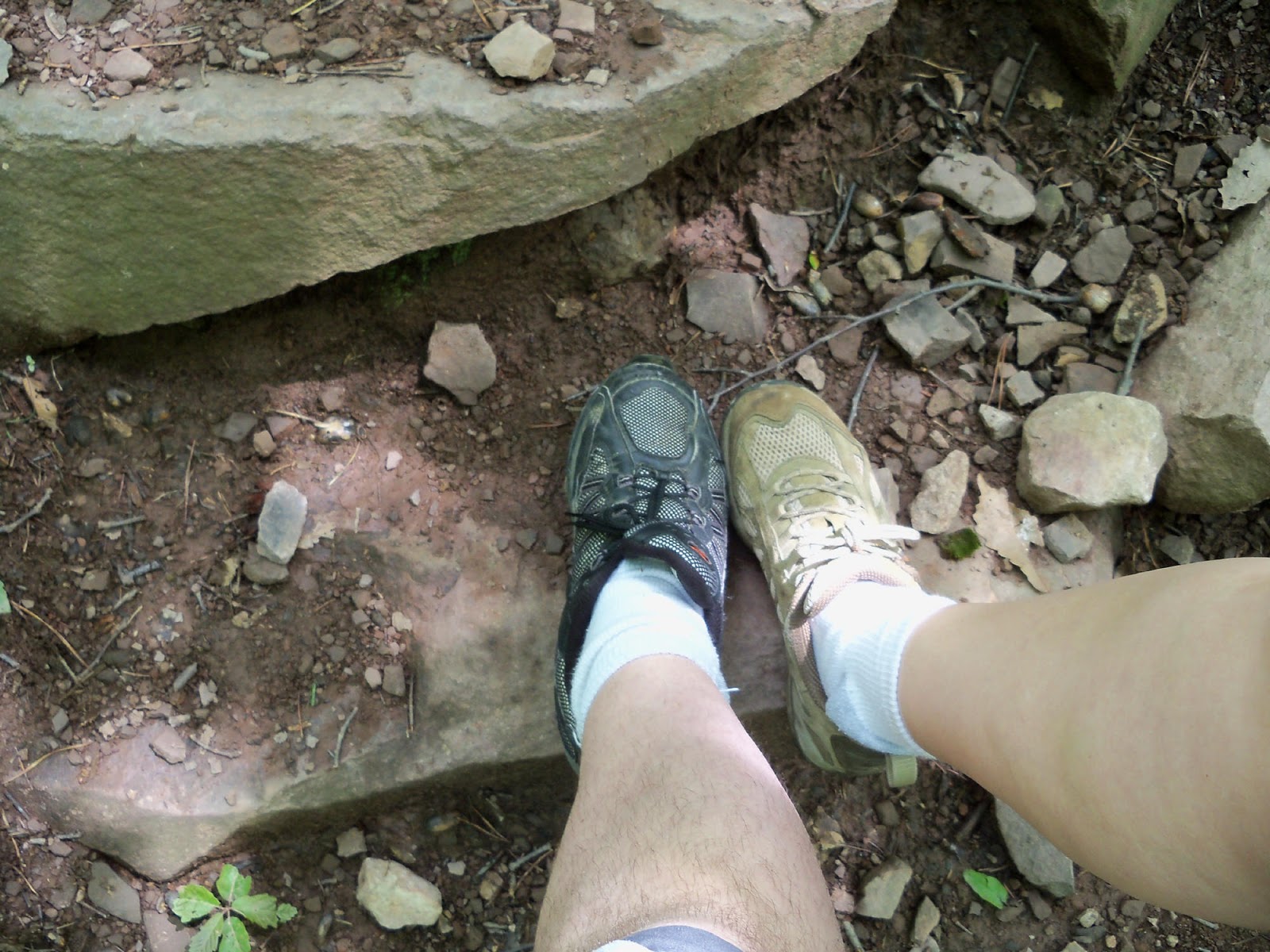
As a Parkinson’s guy with DYSTONIA in my left foot, I will never wear sneakers again, unless it’s a house to car to house trip. Even wandering around Wal-mart will produce a painful sensation on the mid-foot after a short distance (the three cuneiform bones, the cuboid bone, and the navicular bone). This discomfort feels like a nasty consistent annoyance that multiplies the 90° angle that my toes form. And yes, that's painful, too. Believe it or not, in just a short less than a tenth of a mile distance, this makes casual walking painful. Running is out for me, and fast walking, when I don't wear boots, can really hurt, too. Sometimes, I can walk through it if I'm feeling like pushing it, but most times, I can't - even if I try to push it. 
Given the choice of giving up only one of toe or mid-foot issues, I think could walk through the mid-foot, but the toe rearrangements hurt like hell. Thus, sneakers are a thing of the past, even if I had finally got snazzy running ones in 2014 (in the time dystonia was setting in / before PD was diagnosed). Now, it's all shoes that hold my toes in place.


I didn’t hike with sneakers that time. Instead, I had an old pair of ill-fitting Columbia boots, which got wet and created blisters. When I came back, I decided I would pay whatever it cost to never have blisters again. Instead, the guy from EMS put me into a pair of Keen Targhee boots for about half of the price I was willing to pay ($140 - I would have paid over $200 if they said these were blister-proof). He was awesome! I now have a second pair of similar boots from Keen, and I love them. I can see myself getting a new pair when my REI rebate comes in, too. 
By the way, there are regular Taghees and Targee 2s. When it comes to my experience and happiness with them, let’s just say they’ve kept me warm, dry, and safe while crossing streams and enduring Rocksylvania’s finest boulder piles and woodland floor brush. It would be nice to get paid by them to shill, but at this point, I'm just writing out of love for the product.


Additionally, I paid for better-fitting hiking socks, which may have been more expensive, but they provide cushion and avoid blisters. As any hiker will agree, comfort, lack of injuries, and ability to withstand the trail make all of the difference in the world. As a Parkinson’s guy, my body is generally an inferno, so I’m OK there, but my toes get cold (it’s the name of my game). Put simply, I’ve had numb toes sitting at home while just wearing shorts since the rest of me was toasty. I know; I’m an enigma and a conundrum. Thus, I like to have warmer socks on my toes. Not like my snazzy hospital socks, but you get the picture.


This week, I had to replace my old, dead slip on work shoes with nice ones for an interview. Recently, I’ve found that the old ones and even my water shoes / sandals were becoming more susceptible to dystonia pain, so just like with hiking, I found I needed a tight shoe to keep the 90° toe angle from getting in the way of annoyance. I can’t wear hiking boots to an interview, but I do wear them when I go anywhere that involves walking. That meant I needed to bring the CEO of my brain (my wife) along to pick out a good pair for all colors of pants. For work, this involved getting a shiny new pair of dark brown Dockers shoes from Kohl’s, which is one of my wife’s favorite things.


And for all that I wore them so far, I’m happy. The look is sharp and the dystonia is under control. Ideally, I like slip on shoes better, but to look professional instead of relaxed (slipping off my shoes to go stocking footed), I’ll put up with the discomfort by wearing thicker socks and counting my Benjamins before the paycheck arrives. I'm a big fan of money. I have a little, but I’d like more…
The same goes for hiking and walking. I don’t want to give up my movement or my freedom to explore, so I’ll keep looking to stay on my feet with poles, shoes / boots, and socks.


             I hope you do, too. There are many more open roads to explore!

Thursday, December 29, 2016

Do Go Chasing Waterfalls. REVISITED September 2018

(photo credit Rusty Glessner)
            Having time between semesters to regroup is always essential, but it really is making a difference for me now that this term is over with getting through all of my Parkinson’s / Lyme issues. In fact, my Lyme doctor was happy to see me in my ice hiking picture, when I followed up today to tell him I'm getting better, which is always a good thing.

            NOTE - for those people that aren't aware, I was diagnosed with Lyme disease a few weeks after my Parkinson's disease was confirmed. More information about that is HERE.

            I’ve been able to do something of consequence every day, and many days I’ve been out hiking. Some days, it has been simpler things like French Creek State Park with my friend Neil, or other local hikes like to Chickee’s Rock, the Ephrata Rails to Trails, and the Horseshoe Trail by myself. Obviously, there have been holidays in these last just about 2 weeks, but I’ve also had time to catch up on errands and spend time with my family as well, watching a great video on the history, archaeology, and nature of Conowingo Dam in northern Maryland. Tomorrow, my wife and I will leave for Ohio to go and see her family for the next 10 days before the winter term starts at one school. We’ll see a lot of her family, and I should be able to see a friend of mine in Michigan while also getting to do some hiking and writing.
            That’s the one thing that I haven’t done. Between final grades and blogging, I’ve done no work on my novels in progress or the one I want to write let alone editing of things I've already written. I guess I’ll have to put that on the list of things to do in the new year along with losing weight, eating healthy, and traveling to fun places while getting back in shape and continuing to work hard to be a better person.


            Fortunately, I have been hiking. Shaking the Lyme with mega doses of doxycycline has taken the knee pain away, so I’m trying to put the miles back on, and yesterday was no exception as I hiked with Rusty Glessner and Steve Rubano (2 amazing photographers in the nature game) back to the icy falls of Heberly Run, which is within the same general vicinity as Ricketts Glen State Park. Ricketts is a beautiful park, though in recent years, it’s gotten more and more crowded with people looking to partake in the 22 waterfalls over 10 feet. This used to be my favorite place to go in Pennsylvania, but over the years, it fell into a place I really like, but don’t visit much. 

I think I need to go back...


            For waterfalls, Pennsylvania has some great ones. The first waterfall at Glen Onoko (Chameleon Falls) is sweet with the right amount of water. So is the big waterfall at Hornbeck’s Creek / Indian Ladders in the Poconos. I haven’t been there since the first time since it’s a 3-hour haul to get there, and the trail was closed for ages due to hurricane damage. One of these days, I’ll get back up there and do all of the Poconos waterfalls again.


            There are a lot of good waterfalls in the Poconos of northeastern Pennsylvania. Dingman’s and Silverthread look sweet all year long as do the falls of George Child’s State Park. Bushkill is pay to visit, but it also boasts some nice waterfalls if you like yours at the center of an amusement park. Nevertheless, in Pennsylvania, my all-time favorite is Raymondskill’s final bottom drop. It’s not that the top isn’t good; it’s just that the bottom is great.


            Throughout the years, I’ve been to Heberly and the other waterfalls of State Gamelands 13 many times. The best part of this area is Sullivan Run, which is largely uncivilized. Sure, the established trail at Sullivan Falls allows for swimming, photography, and a minimum of injuries to people who are prone to accidents, but other than a pretty much dead road at the top, there is no trail through the waterfalls. Instead, a hiker goes through the creek. I love that idea, and the good Lord willing, I’m going back in next summer with my knock-off go pro to do as much of Jeff Mitchell’s Waterfall Wonderland as I possibly can.

            AUTHOR'S NOTE - my tremors, currently between management, are most likely going to keep me from that in the long term.


            But the key to that is having people to go in there with, and frankly, I couldn’t have winter hiked the Heberly trek with more knowledgeable and capable people than Rusty and Steve. Both of these guys work independently (i.e. set their own schedule at their own jobs) to pay the bills, so they have time to do what they really love, which is photography and hiking back to places to view. Between waterfalls, nature, and astronomy, one of them has probably taken a fantastic picture of it. As for me, a point and shoot kind of guy who gets some really good shots in really awesome places, I appreciate people who can make the average great photo into something awesome. In a world of competitive photographers looking to share their shots, and many of these are also awesome, I know that both of these guys will take their time to make their art fantastic, both at the site and in the studio.

(photo credit Steve Rubano)

            While I had never met Steve before, I had met Rusty before at the Kecksburg UFO festival, which was a really neat event in the middle of nowhere western Pennsylvania if you’re willing to acknowledge that this is your thing. Rusty and his wife, like my wife Heather and me, are unashamedly pro-alien television shows. Do I qualify as Giorgio Tsoukalis Ancient Aliens’ disciple? Probably not, but it’s likely and probable that I do like his show and many other supernatural shows like A Haunting and Monsters and Mysteries in America.


Admit it or not, every boy has an alien / heavy metal interest side. It may be waiting to get out, but really, it’s there! Now, there are good shows and bad shows, and personally, I prefer my shows with some production value, but all that really means is that the narrator sounds menacing and the footage works and isn’t too repetitive. The same goes for cryptids and ghosts. My main rule there is no gore. While I’m not one of the people calling the first episode of this season’s Walking Dead shows too violent (it is a show about zombies), I do look away when it gets ultraviolent.
Here, I must say I don’t do gore… especially my own, which is why it’s nice to have people there on more dangerous hikes… just in case.

(photo credit Rusty Glessner)

The first entrance in for Big Falls was steep. I had may Black Diamond poles, my Kahtoola microspikes, and my warm clothes on for my descent down the 200 foot bank. Both of those guys were experienced, but all steps on the slippery snow and rocks are well-placed, no matter how experienced you are. They have to be. For me, I was much slower, figuring out my balance with my weirdness and tremors in my left leg as well as my hand tremors. For a good deal of the hike, I considered the butt a better way to slide down with the spikes kicking into the ground to stop me. Here, I'm 45, and I'm too old to care what people think. This process worked well, and the hand didn’t shake too much (though I did feel the cold in my knuckles afterward as well as cold in my jaw, which made me slur noticeably - a first in my Parkinson's journey, though that's better now). 
At points, I found myself asking the obvious question (why are you doing this?) and giving the obvious peanut gallery answer (you should have your head examined!) to my response (because it’s there – SLOWLY!).


Soon, I was within about 40 feet of the bottom when I found myself looking for a way to the bottom, which wasn’t presenting itself down the direct path of the ravine I was in. I also found myself altering my approach to using my hiking poles since my right wrist felt jammed up (please don't let that be messed up!) while slamming the poles in for balance and support. Fortunately, the Blackrock poles can handle this (and after the ascent of Big Falls, I never felt it again). Like they say, you get what you pay for.


In another few minutes, I was down at the bottom of the gorge, joining Steve and Rusty for picture opportunities. This waterfall, of the 4 we went to, was the most dangerous hike, the second biggest waterfalls, and the best of the falls we saw. After that, things felt more pedestrian, at least for a little while.

(photo credit Rusty Glessner)

Twin Falls, a 10 or so foot drop in the middle, meant well, and it offered some great pictures, as did the huge Lewis, but Steve and I chose to do that from the top when the stream crossings to get to it from the bottom offered the risk of wet feet and frostbite as opposed to a spectacular picture that couldn’t be taken any other way. 

(photo credit Steve Rubano)

Unlike at Ludlowville Falls in Ithaca, where the car and replacement clothing were close by if bad things happened (and at one point, I did slide into mushy snow, though not water, balls deep on the edge of the creek while moving back into the cave here slowly), getting out from the bottom to the top and down the road at Heberly could have been an hour-long march into sickness and pain. That's not my favorite, so I'm not afraid to call my day in case of concern for being 98.6°.


As the saying goes, hike your own hike, but balance the risk and reward with the gear you have and your confidence in it. Here, Rusty did feel comfortable shooting both Lewis from the bottom and a lesser un-named falls, flowing beautifully on the side, not too far above Twin Falls.

(photo credit Rusty Glessner by Steve Rubano)

For me, I was just happy to be there, confident once again in my winter feet and skills, thinking about how I want to take on Ricketts in ice, should the opportunity come this year (and for that, I would bring my backup snow boots and helmet along with my ice ax and crampons; at Heberly, the conditions just weren’t that icy and cold yet, though they were beautiful).

(photo credit Dennis Crasper)

All in all, it was a great day, and it was made better to be in great hiking company. Here's to more amazing hikes, photos, and life experiences.
Enjoy the winter, however you choose to spend it!