Think / Able - and Check out My Parkinson's Facebook Page

Think / Able - and Check out My Parkinson's Facebook Page
Thanks for coming by! I appreciate it! Click the picture to follow on to my Facebook Parkinson's Page
Showing posts with label Keen boots. Show all posts

Wednesday, May 1, 2019

The Last Hike to Glen Onoko in Jim Thorpe Pennsylvania - Now Officially Closed


My final hike to Glen Onoko was in autumn of 2016. I had just been diagnosed with Parkinson's, so I wanted to see one of my favorite Pennsylvania hikes one last time as part of a quest to revisit some old favorites one last time.

That day, my wife and I hiked up to the 2nd falls. I didn't feel like walking back and forth across a cold creek on that journey, so we didn't go up to the top of the 2nd falls. I had seen the area past that before. The need to see that final small waterfall again didn't matter that much, especially since I was over-conscious of my balance potentially being "off" at that time.

Having hiked to the top of McAfee Knob since then, as well as the back section of Hawk Mountain, I can say I was more rattled about my diagnosis that what I was about to do. After all, I had been compensating with walking changes for 5 years at that point. It's amazing how the body adapts when we go "wonky."


That said, I know my limits and my worries, but at the end of the day, I hike when I can because that's what life is about... enjoying yourself without hurting people (there is a difference). It's just now, if I choose to go somewhere more "intense," I'll find someone to hike with. It's important to be prepared... just in case (and yes, there are some intense places that are "no more" hikes (Ricketts Glen in winter HERE and HERE, for instance - the risk is no longer worth the reward, especially since I have great photos from better days).

But yes, we need to know our limits. That's important, but so is living... as long as our risks don't get others in deep doo doo.


With Parkinson's, gait is a big concern for us youngens with it (I was 40 at diagnosis), as it is for older people with it. As for me, my balance isn't walk on tightropes great, but I haven't fallen yet (knock on wood). Almost 3 years since that date, I'm in stage 2 of 5, which if you don't know Parkinson's, it means I have tremors in both hands. I still hike, but I have dystonia in my left foot, so I hike with poles and solid Keen boots that have lasted for years. I'm at the point where I wear my boots to work as well.


In what is the greatest head-scratcher I can give you, it hurts more to type this blog without shoes on than it does to hike to the top of McAfee Knob (8 miles round trip) because of my clawed-up toes.

This is for realsies, kids.


Someday, I will have to stop hiking because PD will get worse. I don't look forward to that day, but I'm aware it will happen. Most people who go through life find that they have to give up things that they love for some reason or another.

However, we don't want to be told we need to give it up, and we shouldn't put ourselves on a timeline of when that day will be.


For that reason, I went back for one extra hike at Glen Onoko a little while after that last hike after going to the Lehigh Section of the Appalachian Trail with a friend and his wife.. Once again, I only did to the bottom of the 2nd falls, but I did the rocks and the root grabs. I challenged myself and enjoyed it, because I can.

It was a good time, and a fitting last autumnal visit to see an old friend.


Unfortunately, I can't go back anymore, even if I want to. I still physically can, but the trail is now closed due to too many people who can't read danger signs so they stand close to wet edges of cliffs and because they wear flip flops on a trail that requires solid footwear and a conscious decision to not do dumb stuff. 

Too many people got hurt, and now Glen Onoko rests in the peaceful woods.


Let it be known, this sucks, but I don't blame the PA Game Commission. Sometimes, leadership needs to step in. We're not going to agree with all decisions, and I would be lying if I said that I like this one.

However, t would be very expensive to make this beautiful area safe, so I don't fault them for not wanting to be liable or ponying up money to do this. There needs to be buy-in from someone else on this.

After all, Glen Onoko was a free to access trail run by an organization that is funded by hunters, not hikers. To go to a similar waterfall area, made safe from lawsuits (a big worry), PA's Bushkill Falls (pictured below), you would pay $16.50 per person. The only way to make this popular trail safe is money. The only way to keep it accessible is to fund trail maintainers. Without entry fees, this is impossible.

The older I get, the more I realize that if we want areas to play, we need to be a part of that, either through help or money (or both). Tax dollars only go so far to help any cause.


Also, I don't blame rescuers for getting upset about risking their own safety to extract people from unsafe spots when they do dumb stuff like standing too close to watery edges of a steep waterfall. Rescues take skill, access, effort, and money. Yes, accidents happen, and I personally am thankful for when I was with someone who needed rescued and was expertly assisted. Fortunately, that trek out of a canyon was more about walking out with an ACL injury over a rocky path with a few drops and slow down climbs (as well as incredible intestinal fortitude - like pro wrestlers have - mad props, Heather!). The extraction I saw at Ricketts' Glen featured a stretcher on narrow paths. I didn't know the person, but that was some scary stuff.

Those were some awesome people carrying that person out to medical attention. I'm sure the person in the stretcher would agree.


So if I don't blame them, who is to blame? Is this just a combination of what happens when you assemble too many people that are all about the crappy graffiti, remnants of parties, and the flip flop mountain strollers who come into a backwoods area that touches too closely to civilization? Is this selfie culture gone Darwinian like at Yosemite? Who's to say? Sadly, what's done is done.

And those of us who want nice stuff can't have it.


That said, I think it's fair to say most of us who have gone into situations unprepared can relate to the feeling that we're thankful to be 98.6° despite our less than stellar decisions. I know I am, so I'm not here to say all accidents are careless or even that all careless accidents should be accompanied by a lifetime of derision. Live and learn. That's what life is about. Permanent hate and shame are worse than any careless accident..

That said, it's horrible thinking that as of today, it's going to cost me a $100-$200 fine to give up one of the best waterfalls I've ever been to because people didn't get it. In spite of all the warnings, and we knew it was coming to this sooner or later, people didn't take the time to tread with caution.

Too many people poked the bull, and now we all lose. Let's learn the lesson before the next beautiful spot goes. Let's redirect those who need it or help them learn, like we learned to respect nature from those who "gave" it to us.


And let's say a happy thought or 2 for Glen Onoko. It was a great place as my photos show.

More photos are HERE, winter is HERE, and photos when I took my niece are HERE. Photos of the nearby town of Jim Thorpe (one of the coolest towns going) are HERE.


Saturday, February 17, 2018

Hiking Lessons for Mindsets and Feet: Having the Right Equipment is Everything (Especially for Mild Dystonia, Parkinson's, and Hyperhidrosis)!!


            In August of 2013, I had this grand dream. After getting off my chubby butt for the better part of 4 months, I felt that I could do a 5-6 day trek (with backpack) of the entire Standing Stone Trail (under 75 miles or so at the time if you include the distance from parking lot to the sign). I learned many things on the 20 miles of the journey I fought my way through over the 2 days I spent attempting the trail. Most of them were in line with, "Don't think; it can only hurt the ball club." Others were along the line of "rock hiking is slower and tougher than regular hiking."


1)      For me, there was no reward for starting and not finishing a task that isn’t accomplishable. Sure, I went out and experienced a part of it, while learning what not to do next time (a lot of what I did), but that's it. If you're doing something like I did, you know that we get our pictures and memories of what we saw, but if the goal is the finish line, we lost if we don't make it, and if we only go 1/3 of the way, we lost big. Thus, it’s important to have realistic goals and redefine success as pleasure and opening our minds to the flow of losing ourselves in the moment of productive accomplishment. Mihaly Csikszentmihalyi and his take on flow / optimal experience would be proud of us if we could find something we enjoy that much that we can make time vanish while creating / achieving (as long as it's not video game victories).


2)      “Getting to the top is optional, but getting down is mandatory (Ed Viesturs).” From a book that is entitled No Shortcuts to the Top, I should have been learning that a solid overnight back and forth would have been better to start (and at this point in my life, too), but I was electing to go all or nothing, so yeah. Not close and no cigar. I won’t say I’ve given up on over-nighters, but I’d just prefer to hike in and out to shelters instead. Now that I'm diagnosed with Parkinson's, life has changed BIG TIME. I’ve learned I’m more about the experience of seeing neat things than hauling a backpack day after day without a shower or without fresh cold water. As a Parkinson’s person with hyperhidrosis (I wrote about that HERE), I absorb and sweat out water quickly. Having almost 200 ounces of water on a sunny summer day doing 23 miles at Blue Marsh is about half of what I really want for something like that (I also want Clif Shots and gummy blocks - another of my favorite things I wrote about HERE and in its concluding part HERE. This is when I learned how they (and companions) could get me back from Arizona's Wave in 1 piece).


3)     On that note, I learned that there’s no reward for getting seriously injured or killed in some remote wilderness. Emergency rescues cost money. Hospital prices can be brutal, even with insurance (and sometimes, insurance won't cover it). The key is to train extensively and push ourselves just beyond our limits, not to 5 times our limits. Besides, we have people that love and need us. Remember, don't do stupid stuff or s**t.


4)     Always have an emergency way out. Companions for hikes are good, too. I went solo, which was pretty much my only option because I didn’t know anyone to go with. I had met and been influenced by one thru-hiker at the time (Lakeland, who is pretty much one of the premier long-distance elite hikers out there. At the time, he had accomplished the 5,500 Eastern Continental Trail during a year-long hike that also encompassed the Appalachian Trail), and the hike I was going to be on wasn’t going to be his type of hike. Hence, I did mine as a solo journey. Day 2, I woke up with blisters. Ten hours later, I was desperately trying to call my wife from an area of zero cell reception. I finally got in touch with her, but to put it in simplest terms, it wasn’t easy for her to find the unmarked dirt road that I was hiking to (and she was driving a Mini!). Let’s just say, at the end of the day, it’s nice to have someone who loves us enough to keep searching after driving 2 hours to rescue us from dehydration, exhaustion, and blisters. It's even nicer when said person doesn't say, "I told you so."


5)      Don’t carry more weight than you have to. I did. As the character Katz from Bill Bryson’s A Walk in the Woods learned, people will hate your guts if you throw excess weight into the forest. Food weight doesn’t go down fast enough to make it easier to ascend big mountains. Water weight also adds up for us hyperhidrosis types (he says while growling at the ultra-light types!). It doesn’t need to be compounded with lots of extra clothes. It also needs to be replenished quickly. Conserving water isn't smart for a hyperhidrosis hiker.


6)      Having the right equipment is everything! For instance, when the trek was over, I replaced my walking stick with Black Diamond trekking poles. And yes, like Oprah would say, “These are one of my favorite things.” As Lakeland said, they put us in four-wheel drive. It’s true; they do. They also help my Parkinson’s balance and my dystonia left foot as I ascend mountains and traverse boulder fields. Having them and my other essentials for all season (bear mace, Microspikes, and an ice ax) make a hell of a difference in being able to make it through. Someday, I'll be using mine as a "cane."


Prior to the trip, I had bought an REI tent, backpack, sleeping bag, ground cover, and other little supplies to take my Camelbak daypack (another one of my favorite things) and turn it into an overnight pack. I bought a ton of Cliff Bars (another of my favorite things) and dried food since I had no stove to cook with. And yes, they added up in weight. Knowing what I do about the need to stay hydrated on a pretty much dry trail, I'd rather see the trail over spread out days instead of a week straight. And this is what I currently do and have done. It’s better for my Parkie self to stay alive than to push it too hard.


That said, for a hiker, I would say that the most important bit of equipment other than water is whatever happens to or goes on our feet. Now, I carry blister pads. If I went any kind of distance in 2 days, I would have some kind of healing lotion for my paws as well. It might be weight, but anything that can soothe the feet is a good thing.
This brings us to footwear.


As a Parkinson’s guy with DYSTONIA in my left foot, I will never wear sneakers again, unless it’s a house to car to house trip. Even wandering around Wal-mart will produce a painful sensation on the mid-foot after a short distance (the three cuneiform bones, the cuboid bone, and the navicular bone). This discomfort feels like a nasty consistent annoyance that multiplies the 90° angle that my toes form. And yes, that's painful, too. Believe it or not, in just a short less than a tenth of a mile distance, this makes casual walking painful. Running is out for me, and fast walking, when I don't wear boots, can really hurt, too. Sometimes, I can walk through it if I'm feeling like pushing it, but most times, I can't - even if I try to push it. 
Given the choice of giving up only one of toe or mid-foot issues, I think could walk through the mid-foot, but the toe rearrangements hurt like hell. Thus, sneakers are a thing of the past, even if I had finally got snazzy running ones in 2014 (in the time dystonia was setting in / before PD was diagnosed). Now, it's all shoes that hold my toes in place.


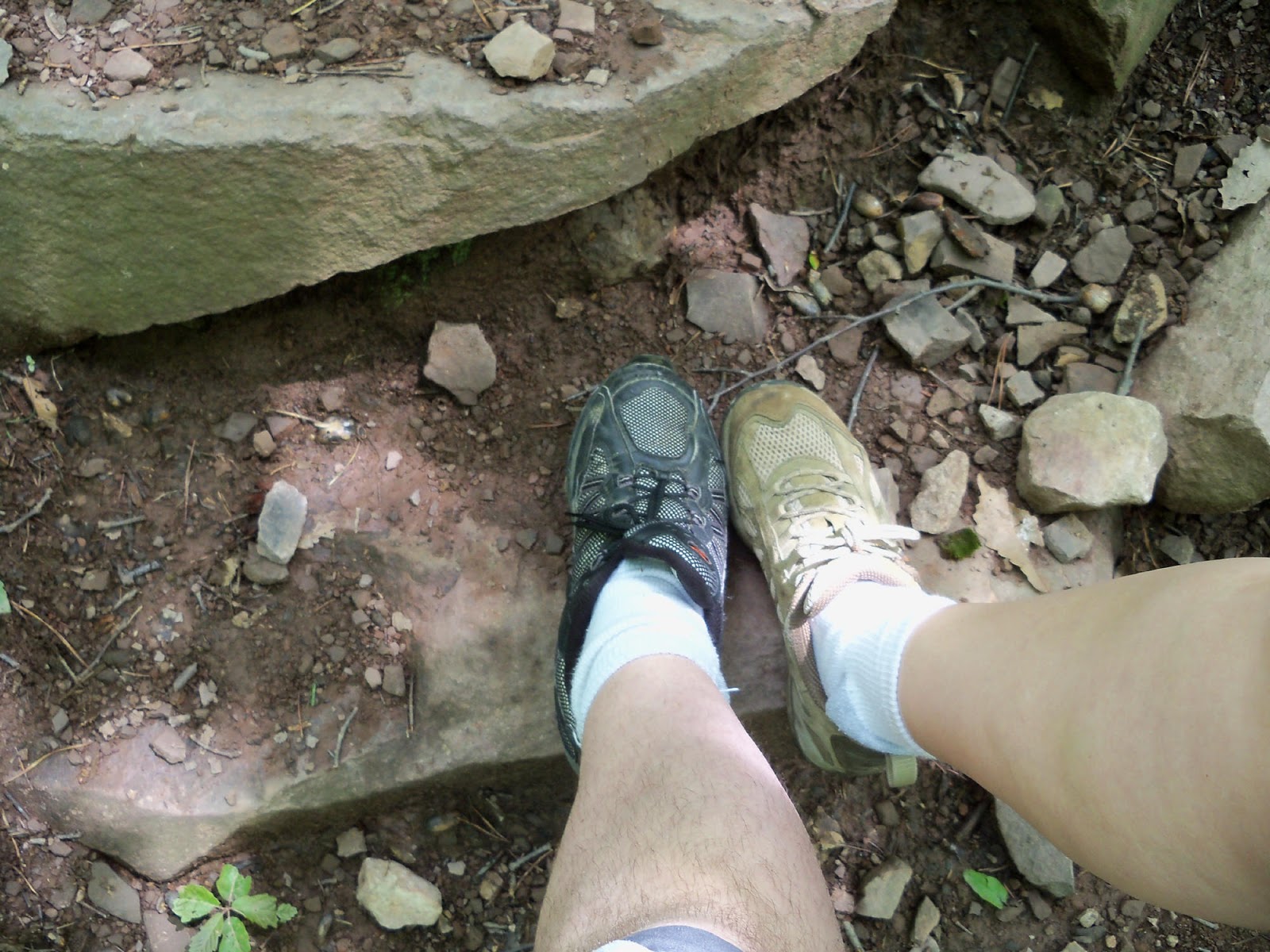
I didn’t hike with sneakers that time. Instead, I had an old pair of ill-fitting Columbia boots, which got wet and created blisters. When I came back, I decided I would pay whatever it cost to never have blisters again. Instead, the guy from EMS put me into a pair of Keen Targhee boots for about half of the price I was willing to pay ($140 - I would have paid over $200 if they said these were blister-proof). He was awesome! I now have a second pair of similar boots from Keen, and I love them. I can see myself getting a new pair when my REI rebate comes in, too. 
By the way, there are regular Taghees and Targee 2s. When it comes to my experience and happiness with them, let’s just say they’ve kept me warm, dry, and safe while crossing streams and enduring Rocksylvania’s finest boulder piles and woodland floor brush. It would be nice to get paid by them to shill, but at this point, I'm just writing out of love for the product.


Additionally, I paid for better-fitting hiking socks, which may have been more expensive, but they provide cushion and avoid blisters. As any hiker will agree, comfort, lack of injuries, and ability to withstand the trail make all of the difference in the world. As a Parkinson’s guy, my body is generally an inferno, so I’m OK there, but my toes get cold (it’s the name of my game). Put simply, I’ve had numb toes sitting at home while just wearing shorts since the rest of me was toasty. I know; I’m an enigma and a conundrum. Thus, I like to have warmer socks on my toes. Not like my snazzy hospital socks, but you get the picture.


This week, I had to replace my old, dead slip on work shoes with nice ones for an interview. Recently, I’ve found that the old ones and even my water shoes / sandals were becoming more susceptible to dystonia pain, so just like with hiking, I found I needed a tight shoe to keep the 90° toe angle from getting in the way of annoyance. I can’t wear hiking boots to an interview, but I do wear them when I go anywhere that involves walking. That meant I needed to bring the CEO of my brain (my wife) along to pick out a good pair for all colors of pants. For work, this involved getting a shiny new pair of dark brown Dockers shoes from Kohl’s, which is one of my wife’s favorite things.


And for all that I wore them so far, I’m happy. The look is sharp and the dystonia is under control. Ideally, I like slip on shoes better, but to look professional instead of relaxed (slipping off my shoes to go stocking footed), I’ll put up with the discomfort by wearing thicker socks and counting my Benjamins before the paycheck arrives. I'm a big fan of money. I have a little, but I’d like more…
The same goes for hiking and walking. I don’t want to give up my movement or my freedom to explore, so I’ll keep looking to stay on my feet with poles, shoes / boots, and socks.


             I hope you do, too. There are many more open roads to explore!